

Our vision
An Africa where every person living with lupus has an equal opportunity to receive timely diagnosis, effective treatment and quality care, no matter where they live or who they are.
Who we are
An African patient-led, patient-centred organisation dedicated to improving the lives of people affected by lupus and other autoimmune conditions across the continent.
Established in 2013, LFA was founded on a simple conviction: people living with lupus in Africa deserve to be seen, heard, diagnosed early, treated appropriately, and supported to live healthy and dignified lives.
Across Africa, lupus and many autoimmune rheumatic diseases remain poorly understood and significantly under-recognised. Many people experience years of delayed or missed diagnosis, limited access to specialist care and essential medicines, financial barriers to treatment, stigma, and inadequate long-term support. These challenges are compounded by health-system constraints and inequalities in access to quality healthcare.
LFA works to help change this reality.
With its roots in Kenya and a growing network of more than 500 active members, including chapters within Kenyan regions and other regions across Africa, LFA is building a grassroots platform through which the voices and experiences of people living with lupus can influence healthcare systems, policies, research and public understanding.
Our ambition extends beyond national borders. We are working toward a stronger, connected African lupus movement that brings together patients, caregivers, healthcare professionals, researchers, policymakers, civil society organisations and partners to address the continent's unique lupus challenges.
Lupus and other autoimmune rheumatic diseases must be recognised not simply as an individual medical condition, but as an African public health and health equity issue.
The impact of lupus reaches families, workplaces, communities and national health systems, while unequal access to diagnosis, treatment, social protection and specialist care continues to place a disproportionate burden on people living with chronic autoimmune diseases.
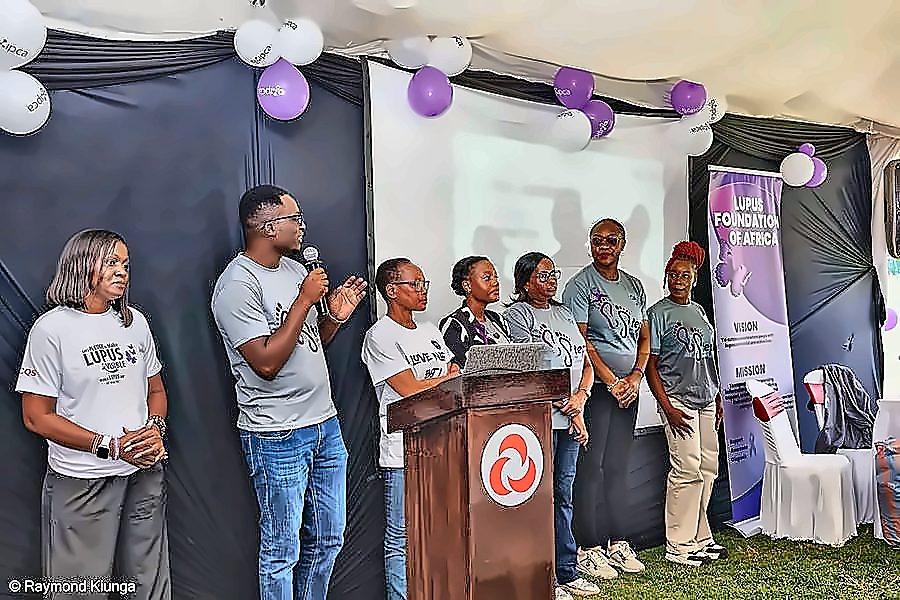
Most of the people at this microphone have lupus themselves. That is not a coincidence, it is the point.
LFA leadership at World Lupus Day 2026, Nairobi. Photo: Raymond Kiunga.
What guides us
Our vision
An Africa where every person living with lupus has an equal opportunity to receive timely diagnosis, effective treatment and quality care, no matter where they live or who they are.
Our mission
To build an empowered African lupus community by providing knowledge and support, amplifying patient voices, and driving action for early diagnosis, equitable access to quality care and effective long-term management.
Our approach
Our integrated approach connects awareness, patient support, evidence and advocacy to drive better outcomes. LFA does this through three pillars.
Build understanding, challenge stigma, amplify patient voices, and influence health policies, financing and systems. This will ensure that lupus is recognised as a public health priority.
Document lived experiences, generate evidence, and translate learning into policy and practice, ensuring decisions are informed by evidence and patient realities.
We aim to connect patients to information, peer and psychosocial support, diagnostics, treatment and practical assistance. This enables people living with lupus to be better supported to manage their condition and access care.
Increase understanding and challenge myths and stigma.
Build peer connection, psychosocial wellbeing and practical support.
Influence policies, financing and health systems.
Generate and use evidence grounded in patient experience.
Help patients navigate and access timely, affordable, quality care.
Our team
Most of the people who run LFA live with lupus themselves, or care for someone who does. That lived experience shapes everything we build. Where a team member has chosen to share their personal story, you can open it below.

Founder of the Lupus Foundation of Africa, Josephine has lived with lupus for as long as she can remember. She holds a Master of Business Administration and has built a career in accounting and credit management, where she serves as a Credit Manager.
Josephine has lived with lupus for as long as she can remember. Diagnosed at a young age, she grew up learning to navigate a condition that often announced itself in ways that were difficult to explain. Her flares began with recurring ulcers around her ears and nose, and at one point, the skin around her armpits turned black. For years, she moved from one doctor to another, particularly general physicians, trying to understand what was happening to her body and how best to manage it.
In 2011, one of her physicians referred her to Prof. Oyoo, a turning point that brought greater understanding and continuity to her care. Since then, she has remained under the care of Prof. Oyoo and Dr. Fred Otieno, who has walked with her through the different seasons of her lupus journey.
In 2013, Josephine experienced one of the most difficult episodes of her illness when she developed a large ulcerative wound on her right leg, extending from her knee to her ankle. The wound lasted from February until August and eventually required treatment in India. She has continued to experience flare-ups over the years, but through treatment, resilience and learning to listen to her body, she has learned to manage her condition and keep moving forward.
But Josephine’s life has always been bigger than her diagnosis. In 2014, she graduated with a Master of Business Administration and has built a career in accounting and credit management. She currently serves as a Credit Manager, bringing years of professional experience, discipline and leadership to the work she does.
Her decision to found the Lupus Foundation of Africa is deeply personal. Having lived with lupus for most of her life, Josephine knows that the challenges extend far beyond the symptoms of the disease. She has seen how difficult it can be for patients to find the right information, appropriate care and the support they need to navigate a lifelong condition. She came to the Foundation because she believes that no one living with lupus should have to figure it all out alone and that patients deserve a community that understands them, advocates for them and works to make their journey easier.
Today, Josephine serves as the Executive Director of the Lupus Foundation of Africa, bringing together her lived experience, professional expertise and commitment to service to help strengthen support for people living with lupus and advance awareness, early diagnosis, access to care and patient-centred advocacy across Africa.
For Josephine, lupus is part of her story, but it is not the whole story. Her journey is one of learning to live with an unpredictable condition while continuing to pursue her ambitions, build a career and create something meaningful for others walking a similar path. Through her work, she hopes to ensure that the people who come after her encounter a healthcare journey with more understanding, more information and more support than she had to find for herself.

An alumnus of Strathmore Business School and a Certified Public Accountant of Kenya (CPAK), Steve has over seven years of experience in project management and business development for start-ups and social ventures in Kenya.
It was 2016, and I was 23 years old when I was diagnosed with systemic lupus erythematosus (SLE). My opinion has always been that illness is something that comes and goes. You may get sick for days, a week, or two, but after that you will feel well again and carry on with your life. Lupus is not only chronic but seems to get worse. I am also battling lupus nephritis. It has been the biggest scare for me so far, as it affects the kidneys and might lead to kidney failure in the future.
Lupus has affected my life both physically and emotionally. When I wake up in the morning, I never know if I will have the energy or ability to do what I want or need to do that day. It can be very depressing. My social and professional life has been adversely affected because I am in too much pain or just do not have the energy to interact with people. Most people do not understand that just because we may look “normal”, we feel anything BUT “normal”. I lost my very first job for illness reasons.
I take about eight prescription medications daily; that gets very expensive even with insurance. Insurance does not cover all medications, which limits the relief available. I see about three different doctors, each a specialist, several times a year. Some weeks are filled with doctor visits or tests, which become very tiresome and expensive.

A development and programme management professional with over ten years of experience across Africa, focused on grants management, donor compliance, programme coordination, partnerships, and monitoring, evaluation and learning. Winnie has worked across education, refugee and humanitarian programming, youth development and social inclusion.
When pain becomes your order of the day, you realise that your days become disordered. My diagnosis with lupus was the beginning of an end to unknown pain and a transition to many unpredictable and challenging days. It was an overwhelming shift and complete overhaul of my once active, spontaneous and carefree life.
My diagnosis took almost five years. In retrospect, I realise the disease may have found its way into my system a while back. I recall occasional joint pains, coldness and numbness of the fingers and toes, and unexplained fatigue. I had been treated for bacterial infections; I think antibiotics knew me by name. After a series of hospital visits and several treatments for numerous diseases, from nerve disorders and enlarged ovaries to pneumonia and magnesium deficiency, I experienced the rash. The facial rash is the most distinctive sign of lupus. It resembles the wings of a butterfly unfolding across both cheeks. That was my turning point. And, like a butterfly, I began to experience life in a way that I never imagined.
One of the most challenging aspects of living with lupus is the lack of awareness around this multifarious autoimmune disorder. Despite the lack of a cure, people can live and thrive with lupus. I have learned to accept my diagnosis. I found a good doctor. I take my medication as prescribed, eat well, and avoid anything that can trigger a flare. The journey is not tranquil, but I keep holding my head up because I am a butterfly warrior.
Today, I use my voice to champion and advocate for people living with invisible illness. Because every single day, many people suffer silently, smiling on the outside while fighting battles nobody else can see. Invisible illnesses are still real illnesses. And invisible battles still deserve visible support.

A Kenyan patient advocate and community leader whose commitment to service is deeply rooted in lived experience. Victoria has lived with autoimmune and other chronic health conditions from birth, including systemic lupus erythematosus.
My journey with chronic illness has shaped my understanding of what it means to be misunderstood. Growing up, frequent absenteeism and the unpredictability of illness often made education a struggle. There were many times when teachers and peers could not understand why I was absent so often, why I could not always participate like everyone else, or why something that seemed simple for others could be physically difficult for me. As I transitioned into a wider society, I encountered another reality: a society with limited understanding of what it means to live with autoimmune and other invisible chronic conditions.
Yet, alongside these difficult experiences, I have also experienced the extraordinary difference that understanding can make. I have been blessed by friends who chose to learn, understand and hold my pain with me in ways I can never fully repay. Those experiences have taught me that an educated and compassionate community can be a game-changer in the life of someone living with chronic illness.
Patient education is also about empowerment within healthcare itself. I have experienced the difference that comes from understanding my body, my conditions, my treatment options, and what does and does not work for me. An informed patient is better positioned to communicate with clinicians, participate meaningfully in decisions about their care, and advocate for themselves.
I believe strongly that quality healthcare is a fundamental human right and that systems should not simply be designed for patients but shaped with them. My work is driven by the hope that fewer people will have to struggle to be understood.

A Medical Laboratory Technologist with several years of experience in laboratory medicine and leadership. Faith is passionate about quality, patient safety, and ensuring that laboratory services are accurate, efficient and reliable.
For ten years, I searched for an answer. Symptom after symptom, doctor after doctor, and no name to put to what my body was going through. That search became devastating in 2023, when I lost my pregnancy at 17 weeks. It was in the wake of that loss that I finally received my diagnosis: lupus.
Ten years is a long time to live without answers. There is a particular kind of exhaustion that comes with being unheard, with knowing something is wrong and not being believed, or not being seen clearly enough for anyone to connect the dots. When the diagnosis finally came, it was heartbreaking that it took a loss so profound to get there. But it was also, in a strange way, a relief. I finally had a name for what I was fighting.
Acceptance did not happen overnight. But once I found my footing, I knew I did not want to carry this alone, and I did not want anyone else to have to either. That is what led me to this community: a place built by and for people living with symptoms like mine, people who understood without needing an explanation.
If you are reading this and you are newly diagnosed or still searching for your own answers, I want you to know: you can live with lupus. Not just survive it, but live. Build a life, chase your goals, and lean on people who understand. It will not look like you imagined, and some days will be harder than others. But you are not alone, and you are not without options.

A marketing specialist and business trainer with experience in marketing and business development, Peace brings communication expertise to amplifying the voices of the LFA community.
My journey with the Lupus Foundation of Africa has allowed me to understand lupus beyond the diagnosis. Although I do not live with lupus myself, being part of the community has given me the opportunity to listen to warriors and caregivers, learn from their experiences, and see the realities they face every day.
I have come to understand that lupus can affect much more than a person's health. Some of its greatest challenges are invisible, influencing energy, work, relationships, plans and everyday life in ways that may not always be understood from the outside. At the same time, I have witnessed the strength, courage and support that exist within the community.
As a supporter, my contribution is to listen, learn, connect, and help amplify these experiences beyond the community. I want to help families, friends, workplaces and the wider public see lupus not simply as a diagnosis, but as a reality experienced by real people with lives, dreams, responsibilities and hopes.

Joyce is a hotelier and an outside catering service provider, and has lived with systemic lupus erythematosus since her diagnosis in the early 2000s.
Back in 2003, I remember vividly how I was running my errands as usual, energetic, and having set my long-term goals in life. Alas! I started having different ailments, from joint pains to chills and fever. At one point, I became immobile, and we had to visit many hospitals, yet there was no improvement. I was devastated; I had lost weight, and my skin started peeling off. I lost hope of living.
Thanks to God, a doctor at St. Mary's Hospital suggested I be tested for lupus. The lab tests were done, and it returned positive for SLE. From then on, hospital visits, admissions and several medications became the norm. I cannot work full time anymore, but I thank God for this so far.
Being in a support group has helped me to cope with lupus, knowing that I have a shoulder to lean on and can express my ups and downs without fear of being judged, and having a family that understands. I am living one day at a time.
Every personal story on this website is published with the consent of the person who shared it. If you are part of the LFA community and would like to share your story, or withdraw one you have shared, contact our team at any time.
Governance & accountability
LFA is a registered organisation in Kenya, governed by a board and accountable to the community it serves.
We publish our impact figures annually and review them with our members. Where a figure is still being verified, we say so rather than estimating. Annual reports, audited accounts and governance documents are made available to members, partners and funders on request while our public reporting library is being built.
Members, people reached, medication support and partnerships as reported in our newsletter for January to June 2026, which also records a national policy engagement with the Social Health Authority. Read the newsletter.
From Kenya to the rest of Africa, LFA is helping build a stronger, more connected and more empowered lupus movement for the continent. There is a place in it for you.